Friday, May 30, 2008

Kayak Diving

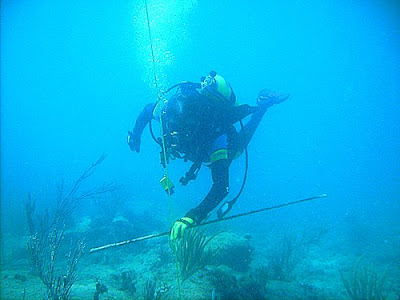
Kayak diving is a great way to visit the site. Also, it's good on gas, and good exercise.


This is the launch point. Our destination is about 3/4 mile away. That's Dick Trodick working on his red kayak. I'm working on my yellow one in the background. The third kayak is going to being used by Dr. Kira Kaufmann, Marine Archaeologist. We are giving her a tour of the Sunrise Wreck debris field this day.

We are checking our gear to be sure that everything is tied down well, and that tether lines are fastened to the SCUBA tank, the buoyancy compensator, gear bag, paddle, etc. We don't want to loose anything in a role over.

Here Dick Trodick is about to change position. The yellow line here acts both as an anchor and a tow line for the kayak. The kayak tows easy. You almost don't notice any drag. It's nice to have your boat with you all through the dive.

Thursday, May 15, 2008

The British Connections

There seems to be enough evidence present to consider that the Fort Lauderdale Sunrise Shipwreck to be of British origin. Some of the artifacts point in that direction. As far as it is known at this time none of the artifacts point to any other origin.

These artifacts, and others, were recovered in 1956/57 from the primary cultural deposit located about 1/2 mile off shore from the beach at Fort Lauderdale, Florida.
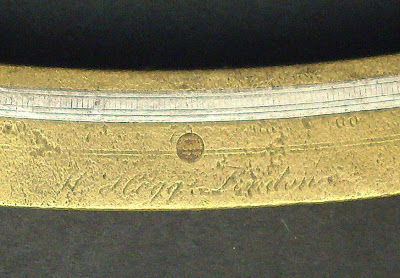


First, there is the sextant with the maker's name and city, "W. Hogg, London".


Then there is the silver or pewter spoon with the name of the maker and city, "P. Barnes & Co., London"


Next, is the pottery shard with a maker's mark, identified as used by John Davenport, Great Britain, 1793 - 1882.


From THE EUROPEAN CONNECTION?
Also, there is this partial saucer or plate of edged pearlware, refined eathernware, England, 1785 - 184o. Note the small piece in the upper right that may have come from another edged pearlware saucer or plate because the edged pattern is curved slightly, in contrast to that of the larger ceramic.


Finally, there are the coins. Of the 40 or so legible Spanish coins recovered, only one was minted in the New World, from the Mexico mint. Note the mint mark on the reverse at about 8 o'clock on this 1788 coin. The rest of the legible coins were minted in Spain.

When we recovered Spanish coins we thought that they must have come from a Spanish ship. It was only a year or two ago that I learned that such an assumption was incorrect. Actually, Spanish coins were the primary medium of exchange in the American colonies, and continued to be so until just before the the American Civil War. There were a number Spanish Mints in the Americas.

So if the ship was a trader plying the waters of the American Atlantic and Gulf coasts, it seems that there should be a large percentage of Spanish coins found with New World mint marks. But, in this case only one of about 40 legible Spanish coins is New World minted.

Of course these artifacts do not prove British origin. It's only that there is likely a connection.

Sunday, May 11, 2008

What is it?

There are some unidentified artifacts in the Ft. Lauderdale Sunrise Wreck collection. Do you know what these two items are. (there are two views of each item.)


Note the threads in the narrow area.


The objects are made of brass or bronze; weight of both pieces together is 1/2 pound; overall length is 5 inches; diameter of bowls are 2 3/4 inches. Also, notice the evidence of threads in the narrow area.

Friday, May 2, 2008

The meaning of the over-stamps.

(This post is being prepared by Matthew de Felice, , County Archaeologist, Broward County Historical Commission.)

Matthew has been very busy and hasn't been able to report his findings. In fact he has not finished his research on these counter stamped coins. Matt has provided me with a copy of his correspondence with Rafael Valentine, a numismatist with some knowledge about the counter stamped Spanish coins found at the Sunrise wreck cultural deposit in 1956.

Rafael says that the counter stamps were made for the island of Cuba. On May 22, 1841 the Cuban authorities recalled the 2 and 4 silver reales minted at Madrid, Seville, Catalonia, Cadiz, and Valencia mints in peninsular Spain. These coins were then struck with the counter stamp and released at a devalued rate.

If this information is correct, then Sunrise wreck could not have wrecked before May 22, 1841, and probably somewhat later to allow for the counter stamping process to be completed. (j.c.n. 11/28/2008).

Monday, April 28, 2008

Cuban overstamped Spanish reales

From OVERSTAMPS

Here is one of the Cuban over stamped Spanish reales.
Click on the coin photo to view the other over stamped coins. Use your back button to return here.

Navigate to: "The meaning of the over stamps" to find the answer.

Sunday, April 27, 2008

The Fort Lauderdale Sunrise Wreck - Wreck date

Until recently we had always assumed that the earliest wreck date possible was 1839. This assumption was based upon the youngest coin found: An 1839 Isabel coin.

However, this has recently been revised due to the diligence of Matthew de Felice, County Archaeologist, Broward County Historical Commission.

In the summer of 2007, I invited Matt, and others, to my home for a showing of the artifacts from the Fort Lauderdale Sunrise Wreck. After Matt arrived, and had surveyed the displays that were spread about, I noticed that he was studying some of the coins, and sketching one carefully. Several of the coins had been struck on the obverse with an over-stamp. It was one of these over-stamps that he was sketching. I have never had a clue as to the meaning of it, until the next day when he messaged me.

Navigate to "Cuban over stamped Spanish reales" to view the coins that bear the over-stamp.

Wednesday, April 23, 2008

"OLD SPANISH COINS FOUND ON BEACH"

"Marvin Grim Discovers 14 Silver Pieces"


"Possibility that Las Olas Beach may once have been the haunt of pirates and buccaneers was evidenced this morning by the discovery of 14 old Spanish silver coins on the north beach ----.

Marvin Grim, 15, found the coins and brought them to the Chamber of Commerce, August Burghard, Chamber secretary, said. The coins, when found, were stuck together by some kind of corrosion, indicating that they may have been in a container at one time. They all bore legible Spanish writing and the dates were readable. Some of the dates were 7775, 1779 and 1801."


Fort Lauderdale Daily News, Tuesday, November 5, 1935, pg. 2.


This 1935 news article was discovered in the summer of 2007 by the staff of the Broward County Historical Commission. Young Mr. Grimm was probably just as excited to find his coins as we were in 1956 when we made our finds. Again, the coin dates coincide well with the other coins found associated with this wreck.

The fact that Marvin's coins were found on the beach leads me to suggest that the hull, or fragments of it, and iron structures are located near where the coins were found.

A search of the 1935 hurricanes leads one to suspect that the 1935 Yankee hurricane uncovered the cluster of coins for Marvin to find. That hurricane came south from off shore of the Carolina's making landfall near Miami Beach as a category 2 hurricane on November 4th Marvin found the coin clump on the morning of November 5.

This was also the year of the Labor Day Hurricane that was a small intense hurricane which came ashore in the Upper Keys on September 2Nd as a category 5. That storm probably caused substantial beach erosion of Fort Lauderdale beaches, helping to uncover Marvin's find.