Sunday, May 3, 2009

11 Assorted other artifacts

There are eleven other assorted artifacts from the Fort Lauderdale Sunrise Wreck. They are all rather interesting. In the web album most of them have multiple views shown. In this post I am providing one view of each to conserve time and picture space. Click on any of the pictures below to view larger and multiple views.


From Assorted other artifacts
This is a composite artifact composed of cork, green bottle glass, calcium deposits iron, and rust stains. The height of the composite is 2 3/4 inch (7 cm.)


From Assorted other artifacts


This is the threaded top of a container. The diameter at the threads is 1 inch (2 1/2 cm.). The material is perhaps bone, but that is not confirmed. The artifact is being held together by calcium deposits.


From Assorted other artifacts


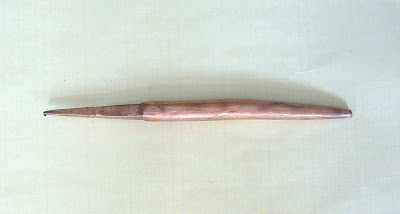
This item appears to be the remains of a pencil. The material projecting out of broken area is a lead tube. It will actually make a mark on paper. The pencil is made of bone or ivory, I think. the length of the item is 3 inch (7 1/2 cm.)


From Assorted other artifacts


This looks very similar to the last "lead pencil" item, although the lead is missing here. Also, the length is the same 3 inch (7 1/2 cm.) This one is a hollow tube throughout. Material also the same - bone or ivory.


From Assorted other artifacts


This also appears to be made of bone or ivory. Length is 3 inch (7 1/2 cm.) I make this out to be a knife handle, or a utensil handle. Note the fastener holes. Only half the handle was found.


From Assorted other artifacts


This piece of hemp rope has retained the curve of its thimble. There is no iron left, just rust. Height is about 3 1/2 inch (9 cm.)


From Assorted other artifacts


This shows the reverse impression left behind after removing coin #40 from concretion. Coin is an 1830 Ferdin VII.


From Assorted other artifacts


This shows another impression left behind after removing a coin from a concretion. Coin is #15 1802 Carolus IIII


From Assorted other artifacts


There was no ballast stone pile at the 1956 cultural deposit excavation. Two small ballast stones were found: One 14 oz and one 12 oz.


From Assorted other artifacts

There was a small amount of coal, the largest being about 2 inch high.


From Assorted other artifacts
One small concretion was kept because it showed signs of copper within. The length of this piece is about 2 inch.

Wood artifacts


There were a few wood pieces found. This piece of wood is the largest found, and measures about 7 inch (18 1/2 cm.) long. It's of a very hard type. It's uncertain whether it is from the ship's wood supply for cooking, however the left end of this piece appears charred. The right end looks like it is rust stained where it may have been pined under some iron, thus keeping it from floating away.

The rest of the wood found consists of seven fragments ranging from 4 1/2 down to 1 1/2 inches (11 to 4 cm.) in length.


Saturday, May 2, 2009

Silver (or pewter) spoon

From Pewter or silver spoon

This silver (or pewter) spoon was found in two pieces. The overall length of the existing pieces is about 7 inch (18 cm.) The inscription on the handle is: "P. Barnes & Co. London". The weight of the combined pieces is: 15.85 oz (44.9 gm).

Click the picture for a larger view.

Friday, May 1, 2009

Iron Artifacts

There were a few iron artifacts recovered in 1956/7. There was flaking from these iron pieces during the fifty some years of storage without any conservation other than keeping them folded up in newspaper in a shoebox, inside, out of the weather. My recent conservation of these pieces consisted of encasing each item in four coats of two part laminating epoxy resin. Below are some of these iron items:


These two links are still interlinked. Combined length is 8 inches (18 cm.).

This partial double (reinforced) link is 3 3/4 inch long (12 cm.)

I believe that these chain links are way too small to serve as the ship's anchor chain. This ship had a draft of approximately 13 to 16 feet, based on the depth of water at mean low tide of 12 ft. where the ship first made contact with this reef, had its hull breached, and deposited all the artifacts that we later recovered.

This iron spike is 7 1/8 inch (18 cm.) long. Weight is about 3/4 pounds.

This is a square head bolt 1 1/2 inch X 1 1/2 inch, 4 3/4 inch long, weight about 1 pound.

This closeup of the square head bolt above shows remnants of threads.

The complete inventory of the iron artifacts can be viewed by clicking the picture above. Use your back button to return to this spot.

Wednesday, November 19, 2008

John Davenport's Mark

Here is a shard with John Davenport's stamped and impressed mark on it. I am hoping that someone is able to provide a valid date range for the use of this particular mark. There is a data sheet with more information below.


From Pottery artifacts


Here is the related data sheet.


From Pottery artifacts


Click on either picture above to view the entire ceramics web album containing 29 artifacts. If you recognize a ceramic, please let me know. Any information would be greatly appreciated. So far the only one reasonably identified and given a date range is #13, a blue edged pearlware - 1785-1840.

Use the back button to return to this site.

Thursday, September 11, 2008

Large anchor raised

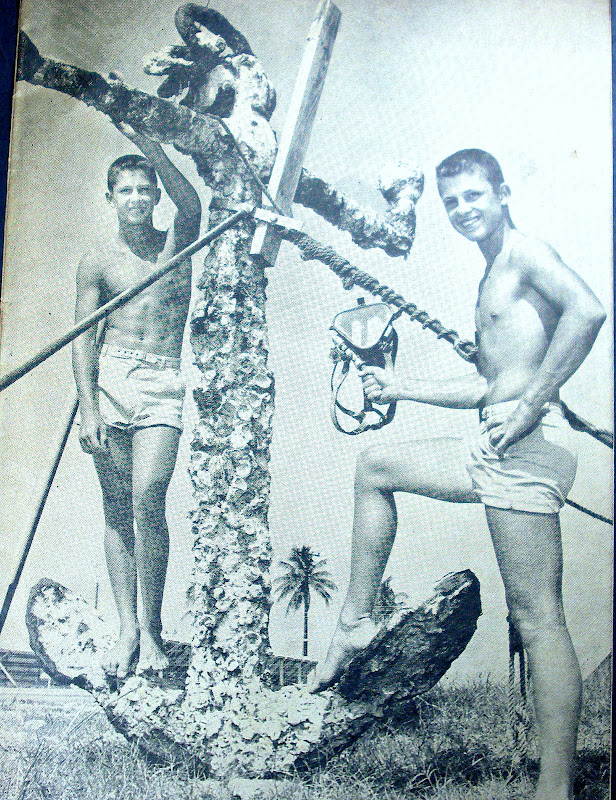
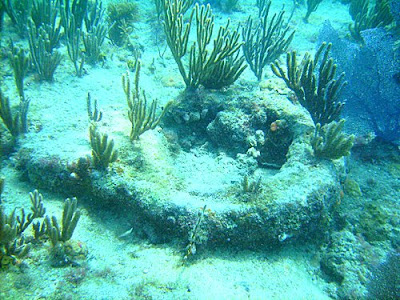
It was Christmas break 1955 and Chuck and I were taking advantage of good weather to explore the nearby reefs for spots that looked favorable for fish collecting. On one of those days we stumbled upon a very large anchor out from Sunrise Blvd. in 32 ft. of water. The length of
the anchor was 9 ft. from the crown to the ring. Here is a photo of the anchor in "Boys' Life" magazine, November 1957.


From Anchor

The anchor was raised in March 1956, with the use of five 55 gallon drums. The drums were filled with seawater on site and taken down, one at a time, and lashed to the anchor. Compressed air was then pumped into drums to displace the water. Each drum was only partially filled in rotation so as to give an even lift when the anchor began to rise. It was a was a welcome sight to have the anchor and drums rise to the surface, and stay on the surface, after ten weekends of struggling with the project.

The weight of the anchor was estimated at 2,000 pounds. That was calculated upon the displacement of seawater for the five drums (8 pounds per gallon X 50 X 5 = 2,000). On the ocean's surface the drums were almost awash, so this is a fair weight estimate. We then plugged the drum holes to contain the air and started towing the whole assembly towards Port Everglades Inlet. The lashings had lengthened considerably due to the burden they carried. The sea was not calm and there was a lot of motion on the drums, so the towing was at a very slow pace for the 2 & 1/2 mile trip to the beach area just west of the north jetty.

Just as we rounded the jetty one of the drums broke loose and the tow settled in about 15 feet of water. Fortunately, we had the foresight not to be in the main channel with it's 40 feet of depth and shipping traffic, which could have been disastrous. As it was, we had the drum refastened and the rig re floated within about an hour and shortly grounded everything on the beach.


Waiting for us there were the buyer, 12 laborers and a large flatbed truck. The men could not lift the anchor. However, they were able to roll it to the truck it on its outstretched appendages and up onto the truck bed.


The anchor was placed, as shown in the picture above, in front of a shell shop in view of U.S.1, a little south of Ft. Lauderdale. It was there for number of years, before it was moved, I understand, to a junk yard and displayed there. I don't know where it is now. Our fee for this effort was $50. Earlier we had offered the anchor to a number of beach hotels without any takers.

The finding of this anchor preceded the finding of the cultural deposit related to the Sunrise Wreck. It is only recently that I realized a possible connection between the two finds, for the anchor was found in about 32 feet of water somewhere seaward of the general area of the cultural deposit. To pursue this idea, I decided to get educated about the history of anchors. I thought that the style of this anchor might help to connect it to the Sunrise Wreck.


After reading, Anchors, an Illustrated History, by Betty Nelson Curryer, and History and Development of the Marine Anchor, by Baldt Anchor & Chain Corporation, it seems that the anchor we raised is called a NEW ADMIRALTY FOLDING STOCK ANCHOR , probably made in England.


The date the anchor was manufactured still needs to be determined, and that will have to be before May 22, 1841, in order to say, "This this anchor could be associated with the Sunrise Wreck debris field".


The Nautical Archaeology Society is sponsoring http://www.biganchorproject.com/ and I will participate in the project by submitting the particulars of this anchor. For now I will make an effort to locate it's present abode, if the anchor still exists. If it is located I may be able to get valid measurements, and photos. I hope that this will help in dating this anchor.


http://www.nauticalarchaeologysociety.org/

Monday, July 14, 2008

Lead Artifacts; Visit Art McKee; New Crowbar

There were also some lead artifacts recovered from the cultural deposit in 1956/7. There are a few featured here:
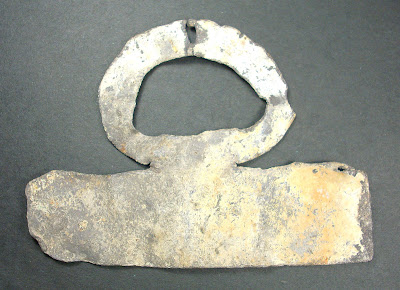
This soft lead item is about 5 & 1/2 inch (14cm) long and weighs about 5 & 1/2 oz (156.5 grams). It looks as if it is some one's makeshift hanger. What do you think it is?

This hard lead item has an outside diameter of 3 & 1/8 inch (8cm). The center has a 3/8 inch (1cm) hole through it. The thickness near the center is 3/8 inch (1cm). The item is shown with its rounded side towards the camera. The other side is flat. The object weighs about 1 pound (0.45kg). It has been suggested that this is a water pump flapper weight. What do you think?

This item represents a supply of lead sheeting used for various purposes aboard ship. This piece was found as shown, folded several times. As folded the item is 4 & 1/2 inch (11.5cm) long; and 1 & 1/2 inch (3.8cm) high. Its weight approx 1 pound (0.450 kg).

At some point in time we unfolded the previous item to see if there was anything inside. There was nothing within. It has now been refolded as it was originally.
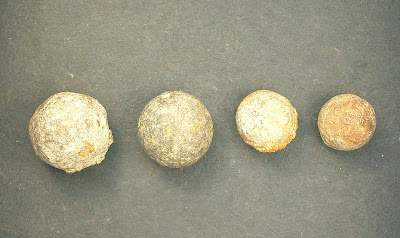
Bear with me as I digress a little with a human interest story. These lead musket balls are part of the artifact collection, but they were found in the Florida Keys by Art McKee prior to the summer of 1956. They possibly were found on the wreck Capitana el rui, or any one of the other wrecks of the Spanish treasure fleet of 1733, or the wreck of the HMS Winchester that sank in 1695 near Carysfort Reef. In other words, I do not know, but if I had to guess, I would say they came from the Winchester. It was a 145 foot British-Man-of-War, and certainly had a great amount of armament, including musket balls. But so did the Spanish, I'm sure. They range in weight from 1.67 oz (47.3g) to 0.66 oz (18.6g).


It happened that the cultural deposit that we had discovered was so encrusted that we could not take it apart with the tools at hand. We decided to seek the advice of Art McKee, a treasure hunter and salvager based in the Florida Keys. We called him and introduced ourselves. We told him about the discovery and the problem we were having getting the debris to come apart. We asked about the use of dynamite, and Art discouraged its use saying that it would do too much damage. He invited us to down to visit with him to see what he had been doing. Shortly, we made the the trip to the Keys.


We arrived at McKEE's MUSEUM OF SUNKEN TREASURE, which was built to look like a castle. I can remember a gigantic stocked anchor, missing the wood stock, on display that must have been at least 17 feet tall within view of the overseas highway.


Art gave us an extensive tour, going into much detail. He showed us the treasure housed inside,including the items in a large safe.


Also, I remember the open yard behind the castle. Back there Art had assembled an actual ballast stone mound, shipwreck timbers, cannons and anchors to resemble a shipwreck, but in air, not water. (I can feel the marine archaeologists cringing).


We finished the visit with an exchange of gifts. We gave Art three of our milled silver coins and Art gave us the four musket balls pictured above. And that was how we acquired the musket balls.


Internet information: "One of the pioneer treasure hunters. Indeed, he is called the 'The father of Modern Treasure Hunting.' Using a diving helmet, he excavated his first wreck in 1938." (Art McKee 1910 - 1979).


P.S. As far as getting any tips on tackling our cultural deposit, we came away from our visit with Art McKee with very little. At least we were advised not to use dynamite.


We had had some limited results using a crow bar. We thought that perhaps a larger crow bar might help. We went to the local junk yard to browse around. Sure enough, there it was, a 6 foot, 30 pound, hexagonal jack hammer rod which we snapped up immediately. Using a new hacksaw blade we cut a chisel point at the working end of the rod. That did the trick. The added leverage allowed us to work away the entire deposit down to the original reef surface.

Click on a picture above to view entire lead artifact inventory.

Use your back button to return to this site.

Sunday, July 6, 2008

Pottery Artifact

The cultural deposit also contained pottery artifacts recovered in 1956 and 57. They add another dimension to the Sunrise Wreck story. Some of them are featured here.


These pieces appear to come from a common pottery artifact. The bottom piece is 3 & 1/2 inch (9cm) long.


This is another view of the top piece in the picture above. It has been tilted 90 deg towards the camera to show the 7/8 inch (2.2 cm) rim. I wonder what this artifact held within when in use?

This dainty flower design was embedded in a 1/2 pound concretion until recently. There were three chocolate brown pieces within the concretion. I took my time to crack it open with the aid of a large bench vise. The vise gave me controlled pressure to crunch specific areas of the concretion. Finally, this small piece of pottery came loose to see the light of day again after 167 years. This little piece is 1 & 1/4 inch (3.2 cm) in height.

There are a number of other pottery pieces with floral designs, and this is one of them. The partial cup is 2 & 3/4 inch (7 cm) in height. There are no maker's marks on this cup.

Another floral piece of cup here. Top edge is finished. Height is 1 & 5/8 inch (4.1 cm).

And another floral one. Length is 1 & 3/4 inch (4.1 cm).

Small piece with a leaf or petal. Height 1 & 1/4 inch (3.2 cm).

And another floral one. Height is about 1 & 1/4 inch (3.2 cm).

There are 6 pottery artifacts with floral designs. Are there enough flowers and leaves to postulate that there was a woman's influence on board ship?

To view the entire pottery inventory click on the picture above.

Use your back button to return to this site.

Friday, June 27, 2008

Some more in situ artifacts

I recently picked up a disk from Dr. Kira Kaufman, our local Florida Public Archaeology Network marine archaeologist, containing additional in situ artifact pictures. So here are some more of the artifacts that have been located within the debris field.

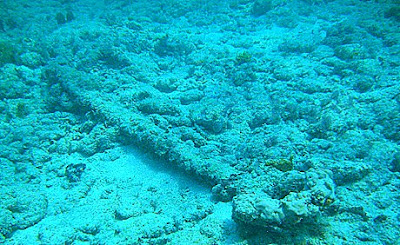
This is an iron rod about 5 & 1/2 ft long with an eye at the end of it. There are two of these in the area.

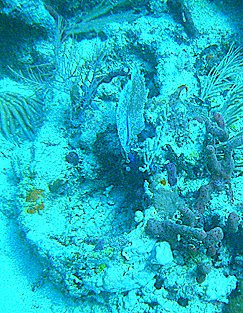
This item I hadn't been able to relocate until recently. I thought it had been taken. But it was there all along, covered with a great amount of growth. It is 24 x 12 x 4 inches, and resembles a figure eight, using imagination.

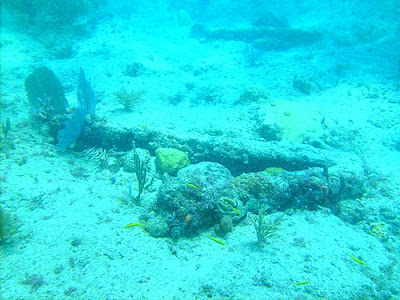
There are two of these "V" shape structures at the site. This I have named the round nosed one. The other, pictured in the background here, I named the square nosed one. The"V" legs of the round nosed structure are 37 & 58 inches. The angle between the "V" is approx 40 deg. These, I have been told, are related to the steering mechanisms. Does anyone Agree?

This seems to be a heavy tackle item, a lifting hook, lying on its side. The overall circumference of this object is 102 inch. The measurements are 38 x 26 x 5 t0 6 inches. I estimate its weight at 200 to 300 pounds. It seems as if rigging gear of this magnitude would indicate that it came from a large ship. The object is fastened firmly to the reef with encrusted matter.

Here is a schematic of the heavy tackle item.

Click on above picture to view the entire in situ artifact web album .

Use your back button to return to this site.

Sunday, June 22, 2008

Glass artifacts

A significant number of glass artifacts were recovered from the Fort Lauderdale Sunrise Wreck cultural deposit in 1956/7. Some of them are featured here:


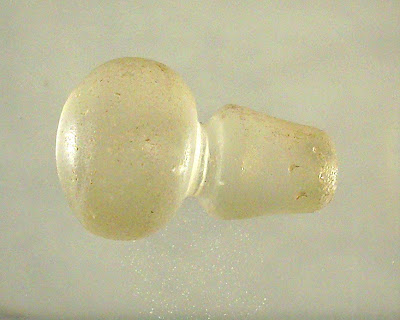
This small clear glass round stopper measures 1 & 1/2 inch (3.7cm)long.


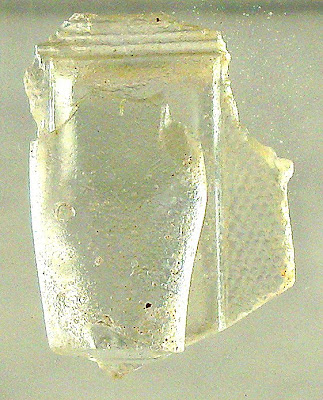
This stopper was also recovered. The top is eight sided, an octagon. It measures 3 inches (7.5cm) in height.


Here is another view of the same stopper. We are looking at it from the stopper end. Look carefully and you will notice a "II" scratched into the bottom of the stopper. Does this mean anything to anyone?


This is a base of a clear stemmed glass. Its diameter is 2 & 1/4 inch (5.6cm). A second one, slightly larger, was also recovered.


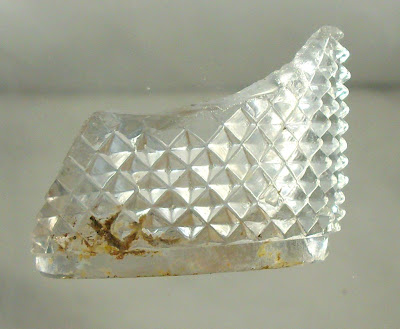
This piece of pressed glassware was recovered along with another piece of exact facet size. I just recently discovered that it fit in a broken area above. It is now more complete.


These two pieces (glued together) are from another glassware object. The facets are larger than with the previous one. This one is fancier, wouldn't you say?


If you study this picture, comparing it to the preceding one, you will see that this partial handle has come from it. The partial handle is 1 & 1/2 inch (3.8cm) in height.


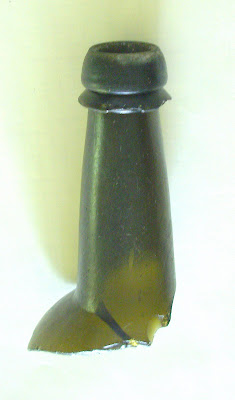
This wine bottle is a clear green. Its height is 3 & 3/4 inch (9cm). Compare this bottle top to the champagne bottle top below.


The champagne bottle top here shows the extra lip built in to secure the cork with twisted wire so it does not pop prematurely.

Click on the picture above to view the entire glassware inventory.

Use the back button to return to this site.

Tuesday, June 17, 2008

Some of the larger cupreous artifacts

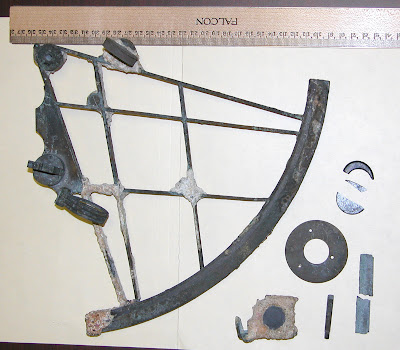
Here is the sextant prior to cleaning and conserving.


The piece in the lower right with concretions on it is the four-shade filter assembly. It was found separate from the sextant.

The claw-like piece in the upper right has a beveled edge and is not like the shade glass of the sextant. However, it does fit in the shade ring snugly. I have parked it for safe keeping in the shade ring with the missing shade glass. Does anyone know what this curved piece of black glass might be?

This is the sextant after cleaning and conservation. There are missing pieces, including the pivot arm assembly, the mirror, the telescope, the handles and 1 & 1/2 shade glasses.

These, approx 6 inch, brass spikes are incredibly hard. I cannot bend any of the six square-shanked spikes with my bare hands. The bends in the spikes above are a testament to the forces applied on them at the time of foundering.

This is the only round-shanked spike found. Length is about 5 inch.

This 4 inch hinge leaf, made from very hard 1/8 inch brass stock, was amazingly torn away from its knuckles and the rest of its hinge.
This approx 7 inch cupreous marlin spike was found with both ends blunted as shown.

Click on the picture to view the entire inventory of cupreous artifacts.

Use the back button to return to this site.